
Your home, run on the cheapest hours.
One schedule for your solar, battery and EV, built from your rate.
Remote. Send your rate plan, a recent bill and your device list.
1:00a.m. Off-peak, 8 cents a kWh on the example rate
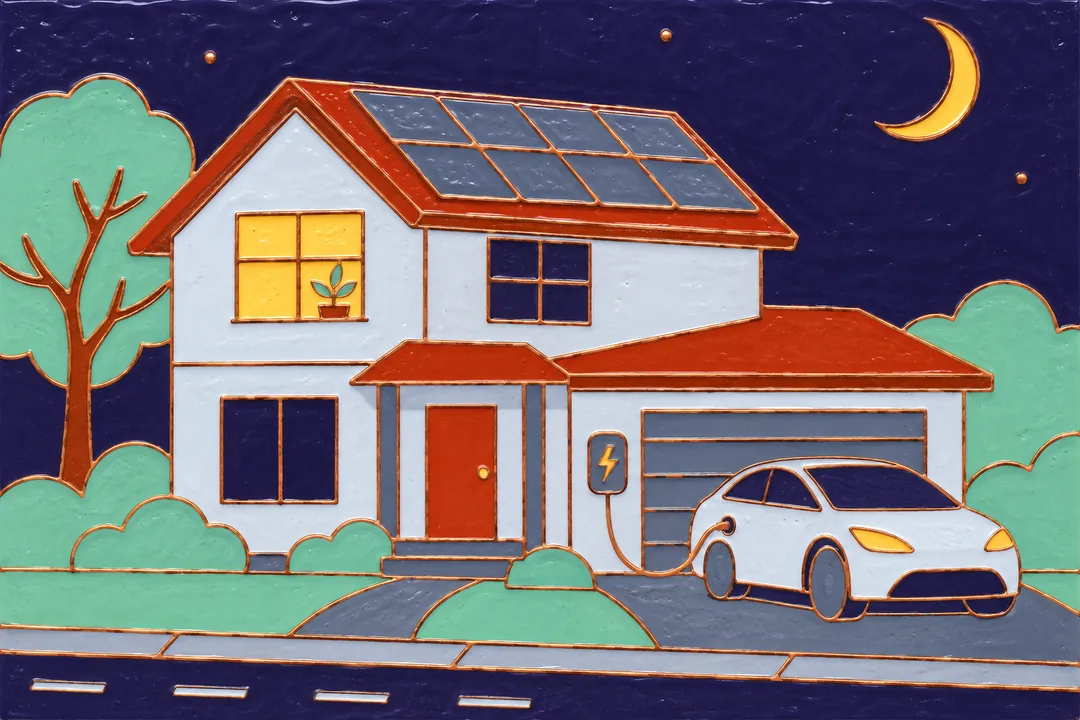
6:30a.m. The day's plan is set
The plan is written before you wake up
Your rate, the forecast, the car's departure and your reserve go in; a plan for every hour comes out. Shown: the fictional example home, a clear April weekday.
12:00p.m. Solar at its strongest
Solar fills the battery before it fills the grid
Exported, a kWh earns 7 cents on the example rate; used at 6 p.m., it saves 31. So the battery fills first. How export credits change the math.
5:00p.m. Peak, 31 cents a kWh on the example rate
The battery carries the house through the peak
| Hour | House uses (kWh) | Solar | Battery | Grid |
|---|---|---|---|---|
| 4 p.m. | 1.4 | 1.4 | 0.0 | 0.0 |
| 5 p.m. | 2.0 | 1.0 | 1.0 | 0.0 |
| 6 p.m. | 2.4 | 0.3 | 2.1 | 0.0 |
| 7 p.m. | 2.2 | 0.0 | 2.2 | 0.0 |
| 8 p.m. | 1.9 | 0.0 | 1.9 | 0.0 |
| Total | 9.9 | 2.7 | 7.2 | 0.0 |
It ends the peak with 5.7 kWh, above the reserve. How battery scheduling decides.
9:00p.m. Off-peak returns
Then the cheap hours go to work

The car
Charges 1 to 3 a.m. at 8 cents; ready by 7:30.

The water heater
Heats off-peak, then coasts through the peak.
11:59p.m. The day adds up
Same house, same day, $1.92 apart
The default home buys 8.4 kWh at the peak price; the scheduled one buys none. One clear spring day is not a month. Every hour of the example home.
Day 30The bill check
Every month, the estimate meets the bill

The bill is the record. Each month the estimate sits beside it, with what moved and why.
TodayYour turn
You send the rate. We send the plan.
From you
- Your rate plan
- One recent bill
- Your devices
- The backup you want kept
From Culni
- Your rate, decoded
- Which devices connect
- The hourly schedule
- Its value, assumptions shown
Seven decisions, made from one rate
Rate Notes
Featured issue:
How time-of-use electricity rates work, and who saves on them
It compares published time-of-use schedules from four utilities and works out, from real tariff prices, the share of peak-hour use at which a time-of-use plan stops beating a flat one.
LouisvilleOffice at 118 East Main Street, Suite 210
Send your rate and your devices
We work with homes anywhere in the US, by email and video call.